 SnapFood
“How many calories should I eat?” is really three questions stacked together: how much do you burn (maintenance), what's your goal (lose, maintain, gain), and what adjustment gets you there sustainably? Here's each one, without the fitness-influencer fog.
Step 1: estimate your maintenance calories
Maintenance = what your body burns in a normal day. The standard way to estimate it is a two-part calculation:
- Basal metabolic rate (BMR) — what you'd burn doing nothing. The widely used Mifflin-St Jeor formula:
• Men: 10 × weight (kg) + 6.25 × height (cm) − 5 × age + 5
• Women: 10 × weight (kg) + 6.25 × height (cm) − 5 × age − 161 - Activity multiplier — sedentary ≈ ×1.2, lightly active ≈ ×1.375, moderately active ≈ ×1.55, very active ≈ ×1.7 or more.
Example: a 30-year-old woman, 165 cm, 70 kg, lightly active → BMR ≈ 1,442 kcal → maintenance ≈ 1,980 kcal a day. A 35-year-old man, 180 cm, 85 kg, moderately active → BMR ≈ 1,805 kcal → maintenance ≈ 2,800 kcal. Same species, 800 kcal apart — which is why copying someone else's target rarely works.
Step 2: adjust for your goal
- Lose weight: eat below maintenance — a moderate deficit of ~300–500 kcal/day typically produces around 0.25–0.5 kg (0.5–1 lb) per week. Deeper isn't better if you can't sustain it; see what is a calorie deficit.
- Maintain: eat at maintenance and watch the monthly trend rather than daily wobble.
- Gain (muscle): a small surplus of ~200–300 kcal/day supports training without disproportionate fat gain.
Very low targets (under ~1,200 kcal/day) shouldn't be attempted without guidance from a healthcare professional.
Step 3: let reality vote
Formulas produce a starting estimate with an error bar — metabolism, NEAT (fidgeting, walking, life) and logging style all vary. The fix is simple: run your number for two or three weeks, log honestly, and watch the weight trend. Losing faster than planned? Add a little. Not moving? Trim 100–200 kcal or add steps. The trend is the truth; the formula was just the opening bid.
Get your number in SnapFood — then actually hit it
- Answer a few questions. During onboarding, SnapFood asks about your body, activity and goal — lose, maintain or gain.
- Get your targets. You receive a daily calorie budget plus protein, carb and fat targets built for you. Not generic numbers — yours.
- Count down by camera. Every scanned meal subtracts from the day's budget: “1,160 of 2,000 kcal · 840 left” at a glance.
- Watch the two panels. “Get enough” (protein, fiber…) and “Keep in check” (added sugar, sodium…) keep quality visible, not just quantity.
- Track the trend. Log your weight in Progress; the trend chart and goal forecast show whether your target needs a nudge.
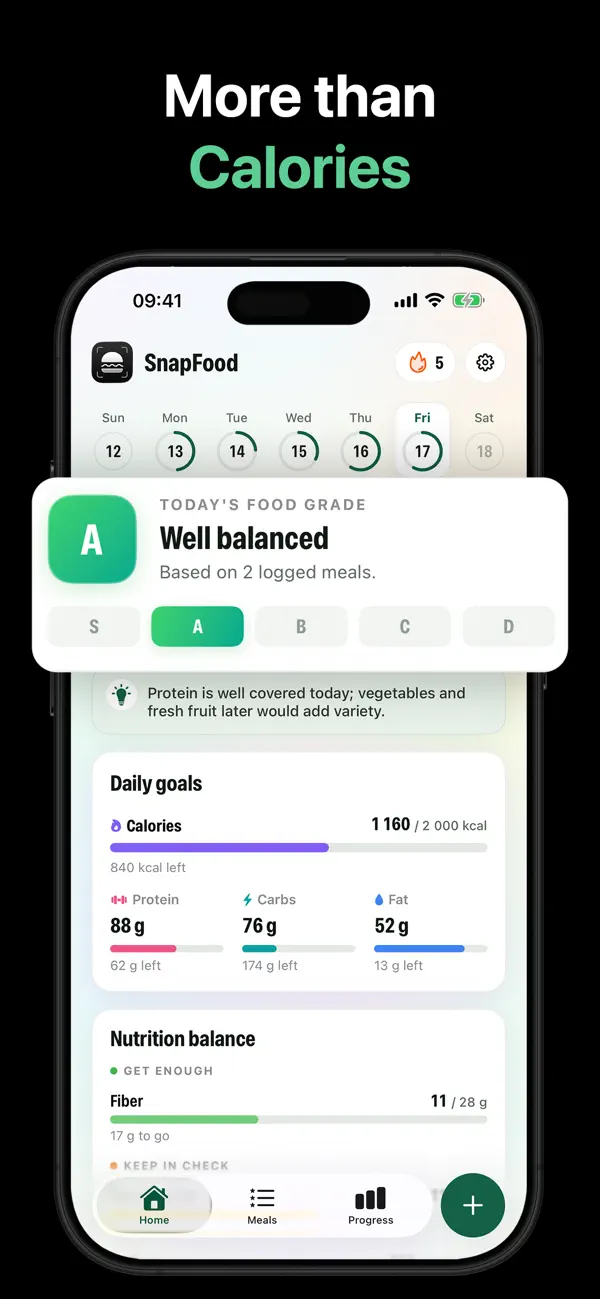
Get a target built for you
SnapFood turns a few onboarding questions into daily calorie and macro targets — then makes hitting them as easy as photographing your food. Free on the App Store and Google Play.
Frequently asked questions
Is 2,000 calories a day right for everyone?
How do I calculate maintenance calories?
Does SnapFood calculate my target for me?
Nutrition values, grades and recommendations in SnapFood are AI-generated estimates and may be inaccurate. This guide is general information, not medical or dietary advice. Calorie needs vary by individual — consult a qualified healthcare professional before making health or diet decisions.